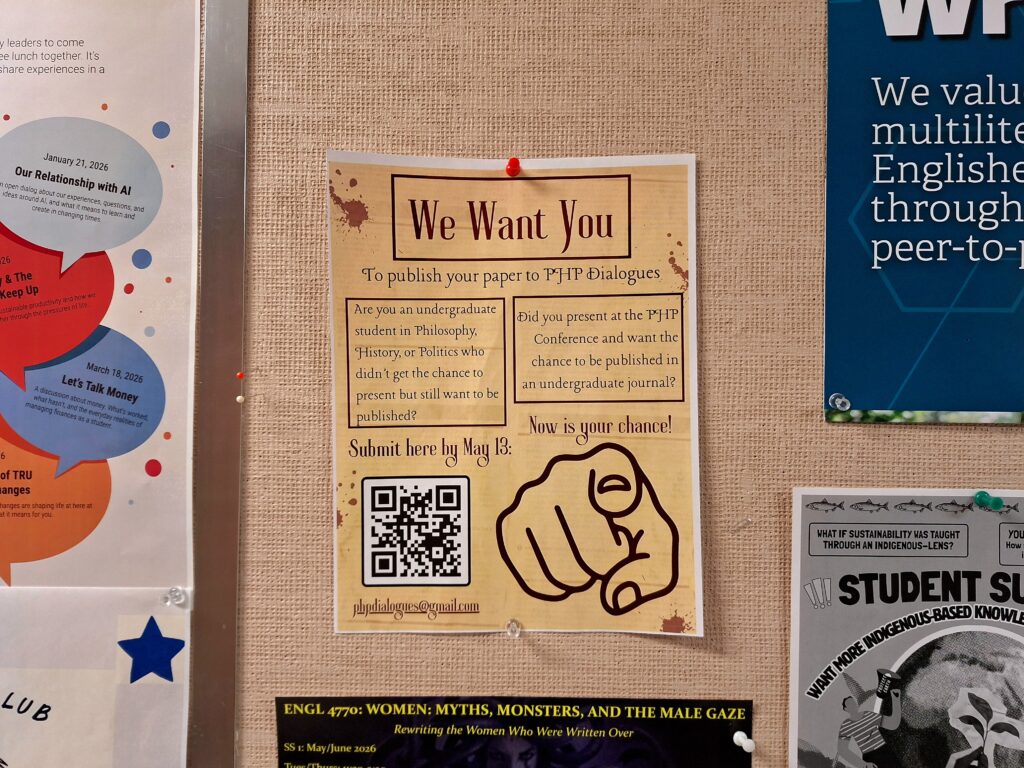
A PHP Dialogue poster is displayed on an announcement board on the second floor of the Arts and Education Building at Thompson Rivers University in Kamloops, B.C. Photo by Mohammadhosein Hasanpour.
Most student writing stays where it begins, in the classroom.
At Thompson Rivers University, PHP Dialogues offers another path. The student-run publication, supported by faculty in Philosophy, Politics, and History, creates space for ideas to move further, beyond assignments, beyond grading, and into a wider academic conversation.
Each issue is shaped by a team of student editors working quietly behind the scenes. They read closely, question arguments, and refine structure, deciding which pieces are ready to be shared. It is careful work, built on discussion, judgment, and attention to detail.
This video features an interview with a member of the editorial committee, offering a closer look at that process. It captures both the responsibility and the purpose behind the role, the task of recognizing thoughtful work and helping it find its place.
Because not all writing should be left behind.
Some ideas deserve more time, more attention, and a wider audience.
PHP Dialogue provides that opportunity, a space where student work shaped by thorough thought is revisited, refined, and heard.
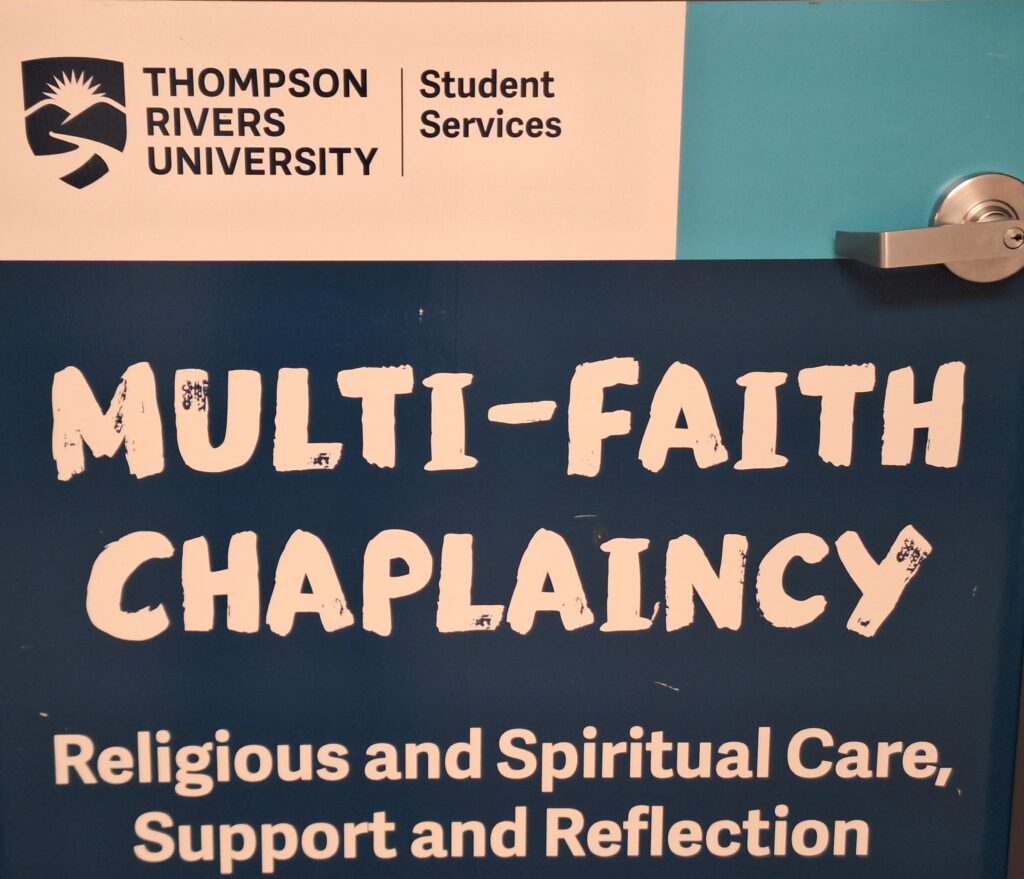
The door to the TRU Multi-Faith Chaplaincy on the ground floor of Old Main (OM1421), Thompson Rivers University. Photo by Mohammadhosein Hasanpour
Walk across the Thompson Rivers University campus and you’ll find spaces for almost everything. Lecture halls for learning. Libraries for studying. Cafeterias for conversation between classes.
But some places serve a quieter purpose.
Tucked away on campus is the TRU Multi-Faith Chaplaincy, a space where students can speak with a chaplain, reflect, or simply take a moment away from the pace of university life. It’s open to students of all faith traditions, as well as those who don’t identify with any religion at all.
The question, however, is not what the Chaplaincy is meant to be. The question is how many students actually know it exists.
To explore that question, TRU students Suzette Netto, a post-baccalaureate student in her last semester, and Jadyn Dsouza, a first-year Bachelor of Business and Supply Chain student, were asked a few simple questions: What comes to mind when they hear the words “Multi-Faith Chaplaincy”? Do they think universities should offer spaces for emotional or spiritual support? And in a time when most campus information spreads through social media, how visible is the Chaplaincy to the students it hopes to reach?
Their answers reveal something simple but telling. While many students believe spaces for reflection and support matter, awareness of the Chaplaincy itself remains surprisingly limited.
Which raises a quiet but important question: On a busy university campus, how many meaningful places remain hidden in plain sight?
An international student shares her experience balancing work, study and immigration uncertainty
When Riya Patel arrived in Kamloops in fall 2023, the biggest challenge wasn’t academics – it was adjustment. Coming from India, she faced a 12-and-a-half-hour time difference, culture shock, and the sudden reality of living alone for the first time.
“I was completely lost,” she said. “You’re here, you don’t know anyone, you don’t have any friends, and none of your family members are here.”
Now in her third year studying communications and digital journalism at Thompson Rivers University, Patel’s days are tightly scheduled. She arranges her classes in the mornings so she can work long shifts at a campus café in the afternoons and evenings. After work, she returns home to cook, study or complete assignments before starting the cycle again the next day.
The Starbucks inside the Old Main building at Thompson Rivers University, where many students work part-time while studying. Mohammadhosein Hasanpour/TRU
“During breaks, it was constantly just work, work, work,” she said. “After a point, you forget the line between reality and that routine.”
Academically, Patel says the transition was smoother than expected. Supportive professors and colleagues helped her adapt to a new education system and workplace culture. The emotional adjustment, however, has been more difficult.
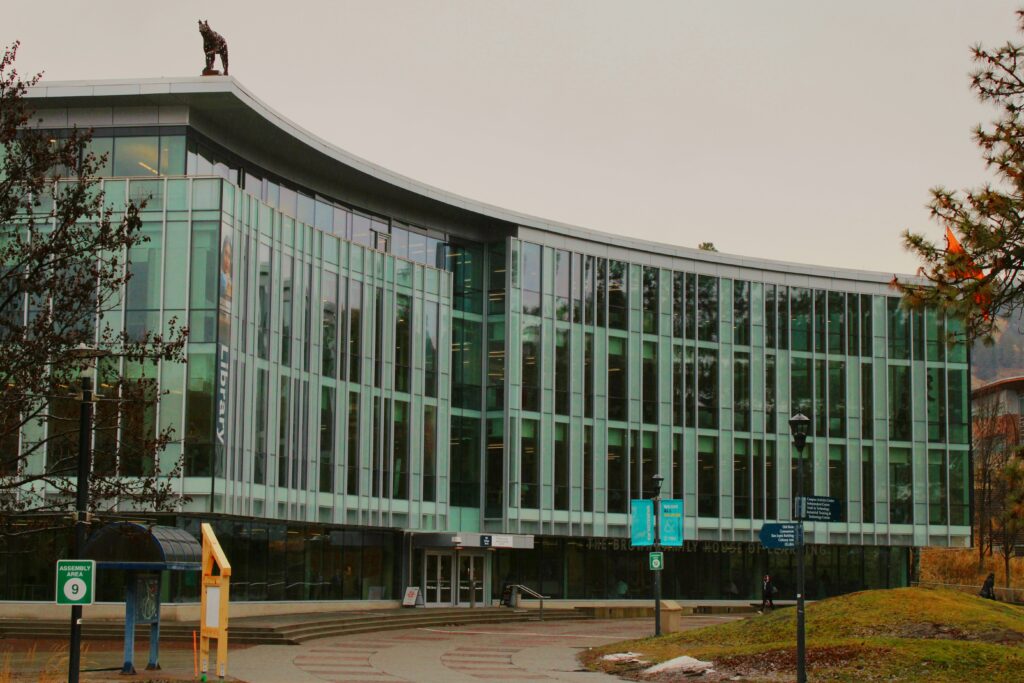
The House of Learning at Thompson Rivers University in Kamloops during a drizzling January afternoon. Mohammadhosein Hasanpour/TRU
Festivals and important family events back home often heighten the distance. “Everyone is there and you’re just here,” she said. “That’s when you feel the most alone.”
Immigration uncertainty adds another layer of stress. Patel is currently studying on a permit that may lead to a three-year post-graduation work permit, but long-term residency remains uncertain. Her parents were recently denied visitor visas despite a strong travel history, a decision she still does not fully understand.
“There’s this constant thought in the back of your mind – what if something happens and your family can’t come?” she said.
She has also witnessed peers struggle with changing immigration policies affecting work permits and family reunification. “People put everything on the line to come here,” she said. “With all this uncertainty, they feel like they’re nowhere – they can’t fully be here, and they can’t go back either.”
Despite these challenges, Patel says community has made a difference. She joined a Bollywood dance club on campus, performing at university events that celebrate cultural diversity. Campus initiatives like International Days help students connect across cultures and ease the feeling of isolation.
She describes Kamloops as more manageable and welcoming than larger metropolitan cities. “It was a good decision to come here instead of somewhere more crowded,” she said.
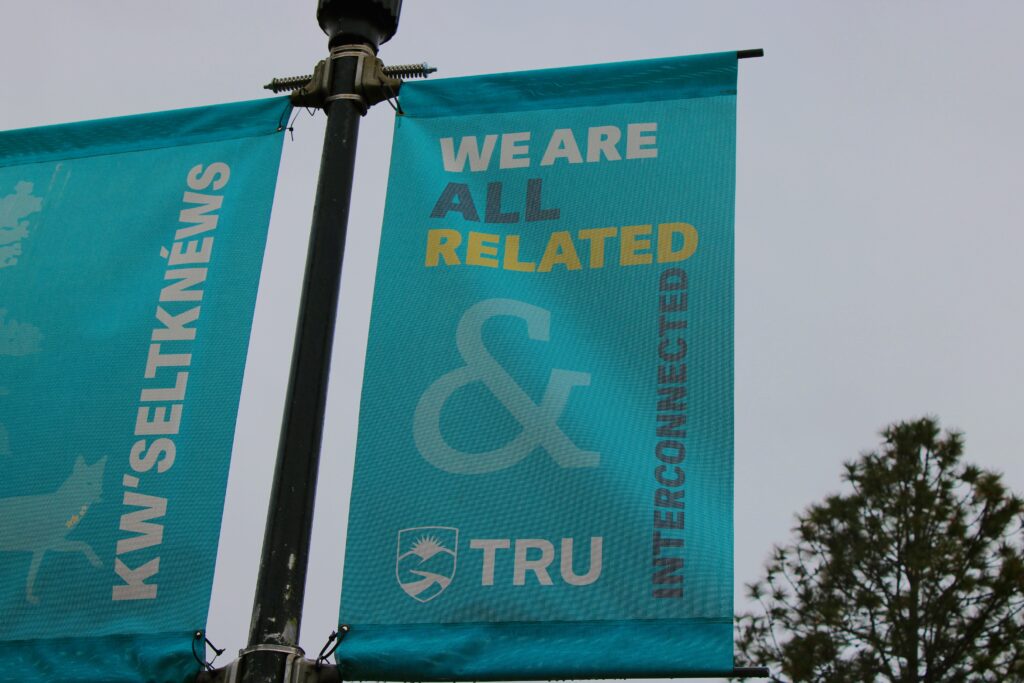
A sign reading “We are all related and interconnected” displayed on the Thompson Rivers University campus in Kamloops. Mohammadhosein Hasanpour/TRU
Ultimately, Patel believes international and domestic students share more similarities than differences.
“Everyone is going through something,” she said. “Just go a little easier on each other. Even the smallest kindness can make someone’s day.”